



Water Balance Assessment
At Geo Costa Rica, we prepare water balance studies to analyze how water is distributed among precipitation, runoff, evapotranspiration, soil moisture and infiltration. This helps estimate potential aquifer recharge and provides evidence for broader hydrogeological interpretation.
Recharge is only one of the pathways that water can follow
A water balance helps explain what happens to rainfall once it reaches the ground: some becomes runoff, some returns to the atmosphere through evapotranspiration, some is stored in the soil, and some percolates deeper and may contribute to potential aquifer recharge.
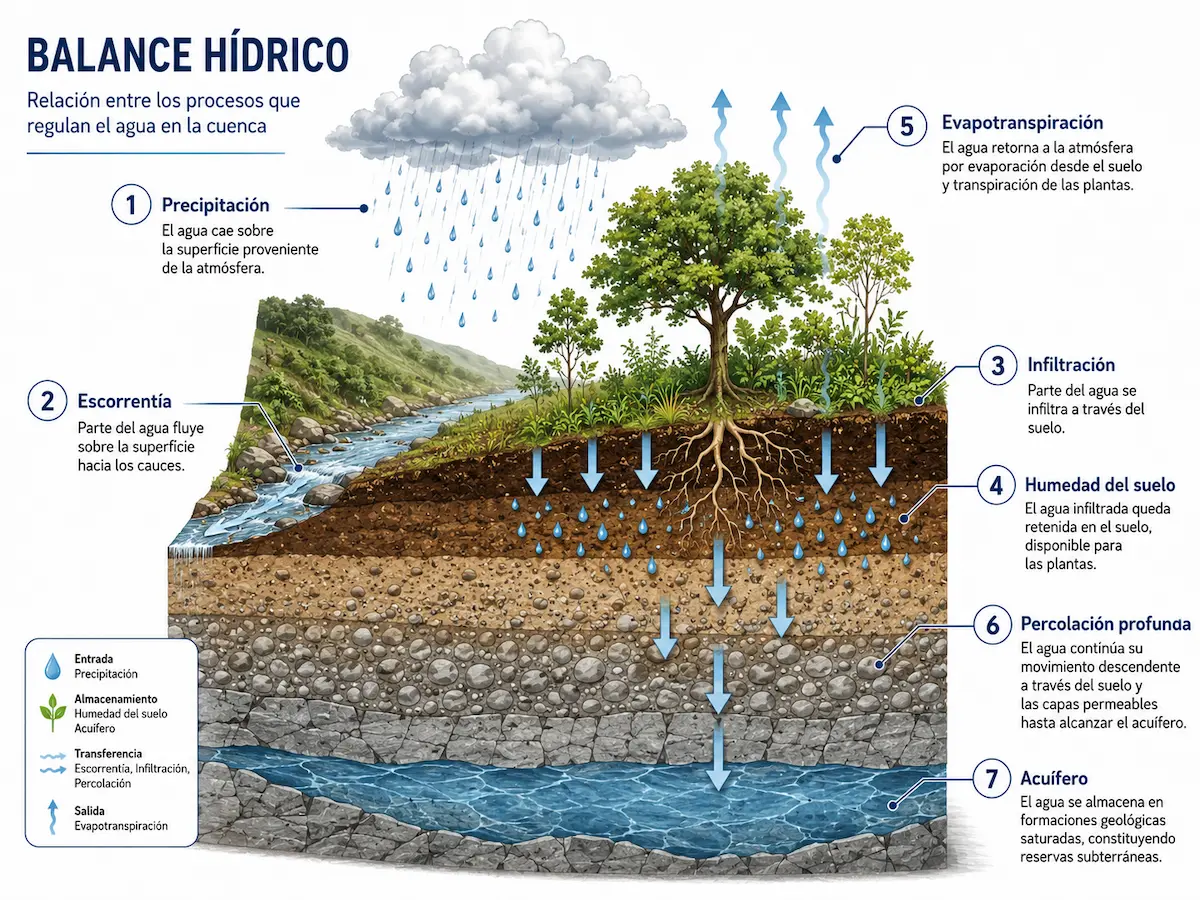
Precipitation is not the same as recharge
Heavy rainfall does not automatically mean high groundwater recharge. Before reaching an aquifer, water interacts with vegetation, soil, slope, land cover and local climatic conditions.
In many projects, a water balance is primarily used to estimate potential recharge based on water movement through the soil and its relationship with climate, land cover and terrain.
The analysis brings together climate, soil, land cover and site conditions
Potential recharge cannot be estimated from a single variable. Climatic and hydrogeological information must be combined to assess water behavior over time, usually through monthly calculations and annual interpretation.
Precipitation and evapotranspiration
Rainfall supplies water to the system, while evapotranspiration accounts for a major part of the water returned to the atmosphere.
Water storage and moisture behavior
Texture, field capacity, wilting point and other soil properties influence how much water can be retained and how much may percolate.
Vegetation and land use
Vegetation affects interception, water use and infiltration processes at the ground surface.
Infiltration and physical conditions
Slope, infiltration and other physical site conditions affect the fraction of water that becomes runoff and the amount that may reach deeper subsurface layers.
A soil water balance is often the basis for estimating potential recharge
In Costa Rica, this approach is commonly applied in hydrogeological studies to estimate potential aquifer recharge. Depending on the case, the assessment may draw on infiltration testing, soil properties, climate data and thematic mapping of the study area.
Potential recharge is one part of the system, but does not by itself represent the full aquifer water balance
Many water balance studies focus on potential recharge. In a broader hydrogeological assessment, that recharge may be evaluated alongside other aquifer inflows, outflows and changes in storage.
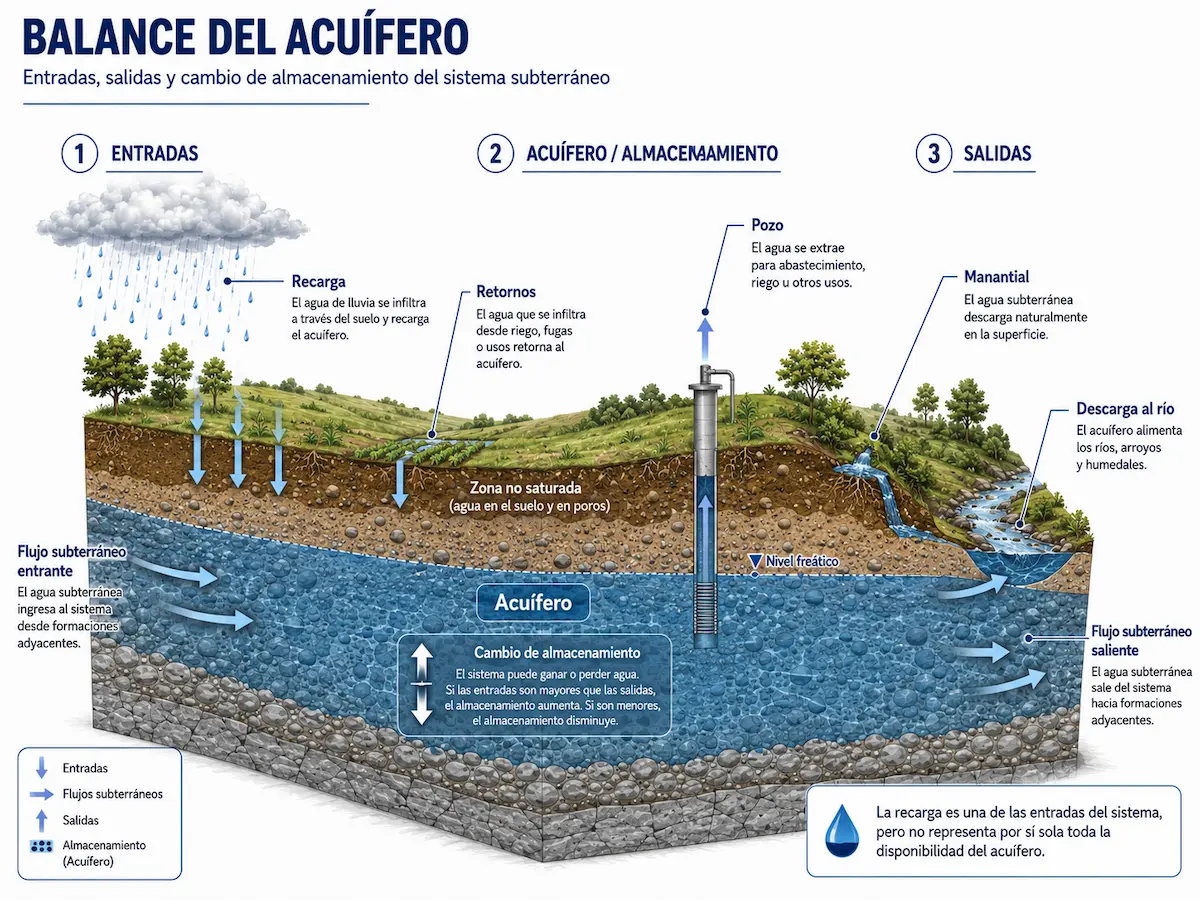
A soil water balance and an aquifer water balance are not exactly the same
Potential recharge estimation
Examines water movement through soil to estimate the fraction that may percolate and contribute to groundwater recharge.
Inflows, outflows and storage
Integrates recharge, groundwater flow, natural discharge, well abstraction and changes in aquifer storage.
Potential recharge does not automatically mean water is available for extraction. Actual groundwater availability also depends on aquifer geometry, hydraulic properties, natural discharge, existing abstraction and overall hydrogeological conditions.
A water balance turns climatic and physical data into information useful for a project
The value of the study lies in converting site, climate and soil information into a quantitative, technical interpretation of potential recharge and its hydrogeological significance.
Values and interpretation
- Monthly and annual potential recharge.
- Results expressed in mm/year.
- Percentage of precipitation that may become recharge.
- Estimated volume or equivalent flow rate, where applicable.
- Hydrogeological interpretation of findings.
Depending on the scope
- Potential recharge maps or zoning.
- Comparison across land covers or site areas.
- Integration with broader hydrogeological studies.
- Support for interpreting water sources or aquifers.
- Technical basis for other reports or related procedures.
Results must be interpreted in light of the study objective
In some cases, the primary goal is to estimate potential recharge; in others, to incorporate it into a broader hydrogeological interpretation. That is why it is important to define from the outset the technical question that the water balance must answer.
When is a water balance useful?
This study is particularly useful when potential groundwater recharge must be quantified or when a project or area requires a clearer understanding of the relationship among water, soil and the aquifer.
Common questions about water balance assessments
What does a water balance assessment analyze?
It examines the distribution of water among precipitation, runoff, infiltration, evapotranspiration, soil storage and potential aquifer recharge.
Are precipitation and recharge the same thing?
No. Rainfall is the main input to the system, but only a fraction may become potential recharge after interacting with soil, land cover and climate.
Does a water balance always represent the complete aquifer water balance?
Not necessarily. In many projects, the primary objective is to estimate potential recharge through a soil water balance. Broader studies may incorporate that recharge into the full aquifer water balance.
Does potential recharge automatically represent water available for extraction?
No. Actual availability also depends on aquifer behavior, hydraulic properties, natural discharge and existing groundwater abstraction.
Request your Water Balance Assessment
Geo Costa Rica prepares water balance studies to estimate potential recharge, interpret how water behaves within a site and provide useful evidence for hydrogeological studies and project decisions.