




Subsurface Disposal of Treated Domestic Wastewater
Geo Costa Rica assesses whether a project can dispose of treated domestic wastewater through subsurface infiltration, analyzing site conditions, infiltration, groundwater levels, wells, available land and the relevant sanitary approval process, and integrating technical and mapping information to support applications before the Ministry of Health.
What does the Ministry of Health regulate?
The Ministry of Health regulates the conditions under which treated domestic wastewater may be discharged into the subsurface through drainage systems.
This process is not limited to carrying out an infiltration test. It involves establishing whether a project can use this sanitary solution and under what conditions.
Subsurface disposal must consider wastewater type, whether sewer service is available, drainage area, setbacks, groundwater depth, nearby water bodies and soil behavior.
Can my project use subsurface disposal?
The first step is to determine whether the activity, wastewater type, treatment system and site conditions permit this final disposal alternative.
Is it domestic wastewater?
This procedure applies to treated domestic wastewater. If the project generates non-domestic wastewater, a different solution is required.
Is sanitary sewer service available?
Drainage fields are acceptable only when an operating public or private sanitary sewer system is unavailable.
Does the property meet the conditions?
Available green areas, infiltration, groundwater depth, setbacks and compatibility with the project must be assessed.
Subsurface disposal should not be selected merely because it is customary. Its technical and sanitary suitability for the actual project must be verified.
Domestic vs. non-domestic wastewater
Wastewater classification fundamentally determines whether subsurface disposal is feasible.
Domestic wastewater
Wastewater from basic human activities such as toilets, showers, washbasins, kitchen sinks and laundry, as well as other wastewater meeting the parameters for classification as domestic.
Non-domestic wastewater
Non-domestic wastewater cannot be discharged into the subsurface through drainage fields. Other treatment and disposal options must be assessed.
Soil with good infiltration does not change non-domestic wastewater into domestic wastewater.
Why is adequate soil infiltration not enough?
A favorable soil infiltration test alone does not establish that drainage fields are feasible for a project.
Feasibility depends on a combination of factors: wastewater type, available area, groundwater level, drainage location, setbacks, sewer availability and the surrounding environment.
- Soil infiltration capacity.
- Sufficient space for the system.
- Available non-public green areas.
- Setbacks from property boundaries and buildings.
- Adequate groundwater depth.
- No available sanitary sewer system.
- Compatibility with the rest of the project.
Infiltration tests
An infiltration test estimates subsurface absorption capacity in the area where the drainage system is planned.
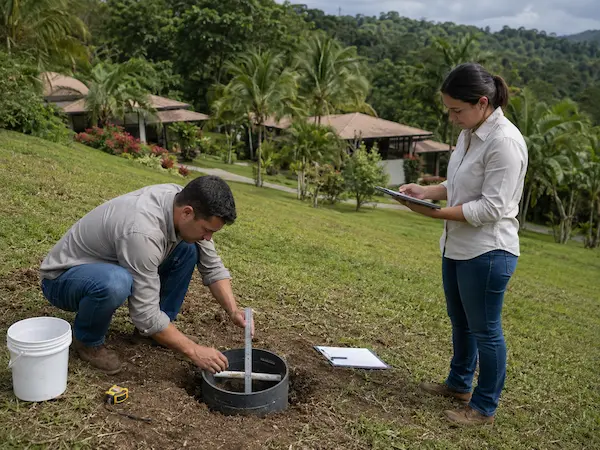
Testing must take place in the area designated for infiltration, rather than at an arbitrary point on the property.
Where a project includes multiple drainage areas or markedly different site conditions, representative testing may be required in each area.
- Selection of the test location.
- Documentation of field observations.
- Recording test results.
- Technical interpretation for the project.
- Integration into the sanitary assessment.
Where may the drainage field be located?
Drainage systems must be installed in non-public green areas and cannot be placed in locations incompatible with their sanitary function.
Non-public green areas
Drainage fields must be located in areas that allow infiltration, access and protection of the system.
Incompatible locations
Drainage fields must not be placed in parking areas, traffic zones, public parks, footpaths, sidewalks, roundabouts or beneath impermeable surfaces.
Drainage fields should not simply occupy whatever space remains. They must be properly integrated into the site design.
Groundwater level, unsaturated zone and groundwater
Groundwater depth and subsurface conditions are essential to evaluating infiltration feasibility.
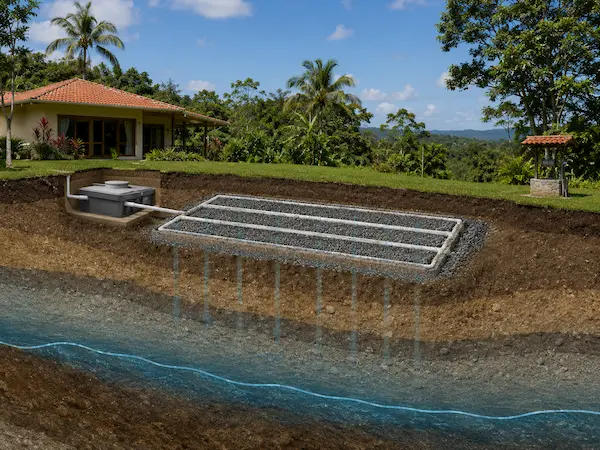
The regulation requires that the groundwater level be at least 1.5 meters.
below the bottom of the infiltration trench. Therefore, assessment must address not only surface soil but also the unsaturated zone, groundwater depth and the system's hydrogeological setting.
- Natural terrain conditions.
- Depth to groundwater.
- Groundwater-related risks.
- Compatibility with the proposed solution.
Wells, buildings, property boundaries and other setbacks
Drainage design must observe applicable setbacks and consider sensitive features both within and beyond the property.
Property boundaries
The system must maintain the applicable setback from property lines.
Buildings
Separation between the drainage field and structures must be assessed.
Wells and sources
Water supply wells and other sensitive water sources must be considered.
Slopes and drainage
Topography and terrain behavior also influence design.
How much space does the system require?
Subsurface disposal may be limited not only by infiltration capacity but also by the actual space available within the project.
Higher flows or more complex projects may significantly increase the area needed for drainage fields.
- Estimated or projected flow.
- Type of treatment system.
- Infiltration rate.
- Lot configuration and shape.
- Site design constraints.
How does Geo Costa Rica assist clients?
Our value lies in combining site conditions, project design and sanitary requirements into a technically consistent application.

What if the site is unsuitable?
A technical assessment may determine that subsurface disposal is not appropriate for the project.
Redesign the solution
It may be necessary to redesign the system or final disposal method.
Choose another area
Another part of the property may sometimes be more suitable.
Consider a different regulatory route
The project may require a different sanitary or disposal alternative.
What does the Ministry of Health review?
The authority evaluates whether the proposed solution meets the applicable sanitary and technical requirements for subsurface disposal.
Eligibility of the procedure
Whether drainage fields are appropriate given wastewater type, available sewer service and project characteristics.
Treatment system and drainage fields
Technical justification, clearly identified locations and consistent documentation are required.
Tests and calculations
The infiltration test, design calculations and site plan are essential components of the application.
Geo Costa Rica does not issue the institutional authorization. We prepare and substantiate the technical application to provide the project with a sound basis.
Relationship with system siting, plans and other requirements
Subsurface disposal is often linked to other project decisions and institutional procedures.
What information do we need to begin?
Clear project information allows us to determine more quickly whether subsurface disposal is a realistic option.
Property information
- Cadastral survey plan.
- Property location.
- Available site plan.
- Usable area and known restrictions.
Proposed development
- Intended land use.
- Expected occupancy or capacity.
- Actual or projected water consumption.
- Preliminary system location.
Proposed sanitary solution
- Wastewater classification.
- Proposed treatment system.
- Planned final disposal method.
- Available studies and background documents.
How do we approach subsurface disposal?
Our goal is to establish whether the solution is feasible and document it clearly for the relevant regulatory process.
Questions about subsurface disposal before the Ministry of Health
Answers for projects considering drainage fields as a sanitary solution.
What is subsurface disposal of treated wastewater?
It is the controlled infiltration of treated domestic wastewater into the subsurface through purpose-designed drainage systems.
Does it apply to all types of wastewater?
No. This procedure applies to treated domestic wastewater. Non-domestic wastewater must not be discharged into drainage fields.
If the soil infiltrates well, may I use drainage fields?
Not necessarily. Available space, location, groundwater depth, setbacks, wastewater type and sewer availability must also be assessed.
What if sanitary sewer service is available?
If an operating public or private sewer system is available, that alternative must be considered before opting for drainage fields.
Where may the drainage field be located?
In non-public green areas. Drainage fields must not be located in parking areas, footpaths, sidewalks, playgrounds or beneath impermeable surfaces.
How deep must the groundwater level be?
The regulation requires at least 1.5 m between the groundwater level and the bottom of the infiltration trench.
Are infiltration tests required?
Yes. Test results form part of the technical evidence used to evaluate subsurface disposal.
What if the project exceeds 190 m³/month?
The regulation provides differentiated requirements for projects with actual or projected water consumption over 190 m³/month, including operational reports and effluent quality compliance.
Does Geo Costa Rica design the entire system?
Geo Costa Rica focuses on territorial assessment, infiltration, groundwater, mapping, technical support and application assistance. Specialized design tasks requiring other professional qualifications are coordinated with the appropriate specialist.
What if the site is unsuitable?
That outcome is also valuable: it allows the project to be corrected in time and alternative sanitary solutions to be assessed before proceeding with an unfeasible approach.
Related studies and procedures
Depending on the project, subsurface disposal may be associated with other technical studies or institutional requirements.
Wastewater Treatment System Siting
The location of the treatment system and drainage fields must be properly integrated with project layout and territorial constraints.
Sanitary Sewer Exemption
Some residential projects need this procedure to justify an individual sanitary solution.
Wastewater Treatment Systems
A related resource explaining the complete sanitary solution and alternative final disposal routes.
Would you like to know whether your project can use drainage fields?
We can review the property, proposed sanitary solution, infiltration, groundwater level, wells, available area and project layout to determine whether subsurface disposal is feasible.
Send us the cadastral plan, site design, project type and any available system information for an initial technical assessment.